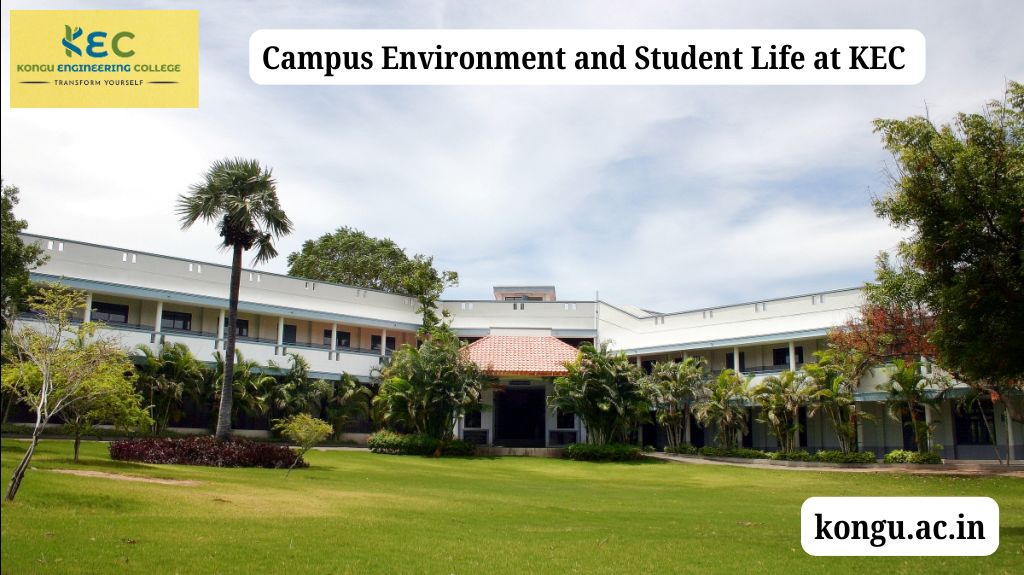
Kongu Engineering College is located on a large, self-contained campus at Perundurai. The campus environment and student life at Kongu Engineering College is maintained as a green and organised academic space with dedicated facilities for instruction, residence, sports, and student services. Institutional practices related to cleanliness, landscaping, and waste management are implemented as part of campus maintenance. The campus is Wi-Fi enabled and includes academic blocks, laboratories, hostels, sports grounds, service buildings, and common facilities required for daily student life. Residential Facilities and Hostel Life On-campus hostel facilities are provided separately for boys and girls. Multiple hostel blocks function under appointed wardens and established hostel rules. Residential facilities are supported by: Hostel operations follow prescribed timings and entry procedures as published in institutional rules. Guest houses and staff quarters are also available within the campus. Transport and Daily Mobility The institution operates its own transport system to support daily commuting for students and staff. College buses connect the campus with nearby towns and surrounding regions. Transport services are managed with designated routes, schedules, and safety measures as part of institutional administration. Student Activities and Organised Engagement Student participation is coordinated through recognised clubs, associations, and institutional cells. Activities are conducted under faculty supervision and institutional approval. Student engagement includes: Events, workshops, and programmes are conducted as part of student-centric activities reported through IQAC and annual documentation. Sports and Physical Education Sports activities are managed by the Department of Physical Education. The campus includes facilities for both indoor and outdoor games. Available infrastructure includes: The college conducts regular coaching programmes, inter-college tournaments, and annual sports events such as the Kongu Trophy and Sports Day. Student Support and Welfare Services Student life is supported through formally constituted support systems. These include: Faculty mentoring and counselling structures are documented as part of institutional student support practices. Health, Food, and Campus Services The campus includes a medical centre with ambulance services. Food facilities such as canteens and food courts operate within the campus. Additional services include: These facilities support daily student requirements as listed in campus infrastructure disclosures. Discipline and Campus Regulations The institution follows a published Code of Conduct governing attendance, classroom discipline, hostel rules, and campus behaviour. Regulations related to mobile phone usage, dress code, and student conduct are documented. Anti-ragging policies are enforced in accordance with statutory guidelines. Campus Life within the Institutional Framework The Campus Environment and Student Life at Kongu Engineering College are organised through documented facilities, approved activities, and regulated support systems. Academic schedules, residential arrangements, student services, and co-curricular participation function within clearly defined institutional structures published by the college.
Research and Innovation at Kongu Engineering College, Perundurai
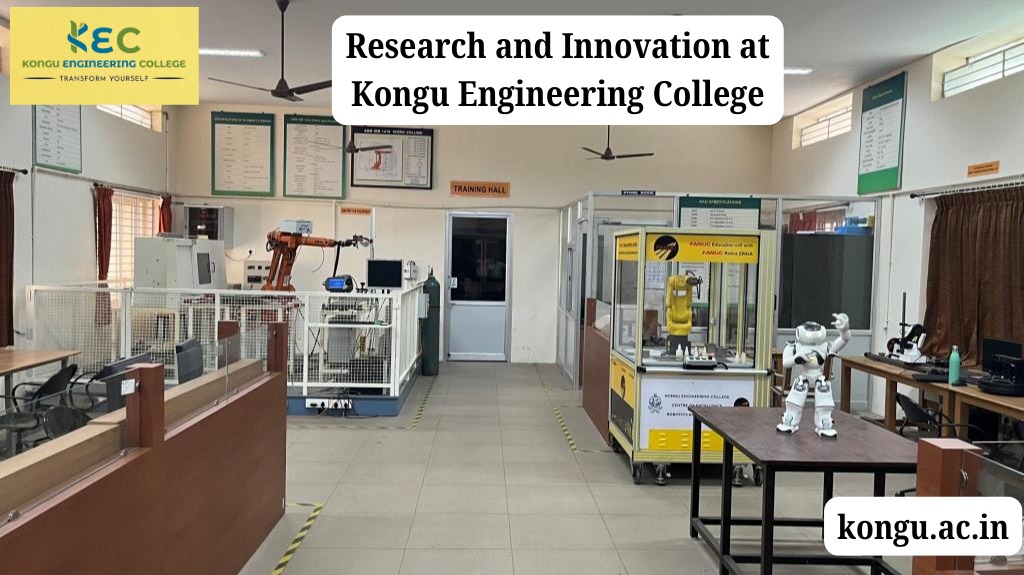
At our institution, Research and Innovation at Kongu Engineering College form an integral part of academic life alongside teaching and learning. We maintain a structured research ecosystem that supports faculty members, research scholars, and students in carrying out research, development, and innovation activities within an organised academic framework. All research activities function under documented institutional policies and approved academic committees. Through coordinated departmental processes, research work follows Anna University research regulations and institutional norms, ensuring academic discipline and consistency across programmes. Research and Development Structure Research activities at our college are coordinated through a central Research and Development Cell. This cell oversees all research programmes, including those registered under Anna University, and monitors progress across academic departments. Our institution has 20 Anna University–approved research centres spanning engineering, emerging technologies, sciences, humanities, and management. These centres admit both full-time and part-time PhD scholars from within the institution as well as from external organisations. Recognised research centres function in departments such as: Research Areas and Academic Contributions Research and Innovation at Kongu Engineering College span a wide range of engineering and applied science domains. Key focus areas include: Our faculty members and research scholars contribute through journal publications, conference presentations, and participation in academic forums. Research activities and outcomes are documented through institutional research communications and annual reports. Funded Projects and Intellectual Property Support As part of Research and Innovation at Kongu Engineering College, our faculty members submit research proposals each year to national and institutional funding agencies. These proposals support: The Research and Development Cell supports intellectual property initiatives across departments. Patent filing, copyrights, and related IPR processes are encouraged as part of applied and technology-oriented research carried out by faculty members and students. Innovation, Incubation, and Entrepreneurship Our campus supports innovation through structured institutional platforms. The Technology Business Incubator provides incubation space, mentoring support, and shared facilities for technology-based start-ups. Innovation initiatives are supported through: These platforms facilitate idea development, prototype activities, training programmes, and innovation-focused academic events within institutional guidelines. Research Facilities and Laboratories Research activities are supported through department-based laboratories, Centres of Excellence, and shared research facilities. Departments maintain specialised laboratories used for research projects, consultancy work, and industry-supported activities. Centres of Excellence provide advanced infrastructure in areas such as robotics and automation, virtual and augmented reality, and energy studies. Centralised testing and consultancy facilities further support applied research and industry interaction. Role of Research and Innovation in Academic Life Research and innovation play a continuous role in academic development at our college by integrating inquiry-based learning with structured academic processes. Through organised research centres, institutional policies, and dedicated support systems, we sustain a stable research environment that complements curriculum delivery and formal teaching
Career Transition and Placement System at Kongu Engineering College, Perundurai
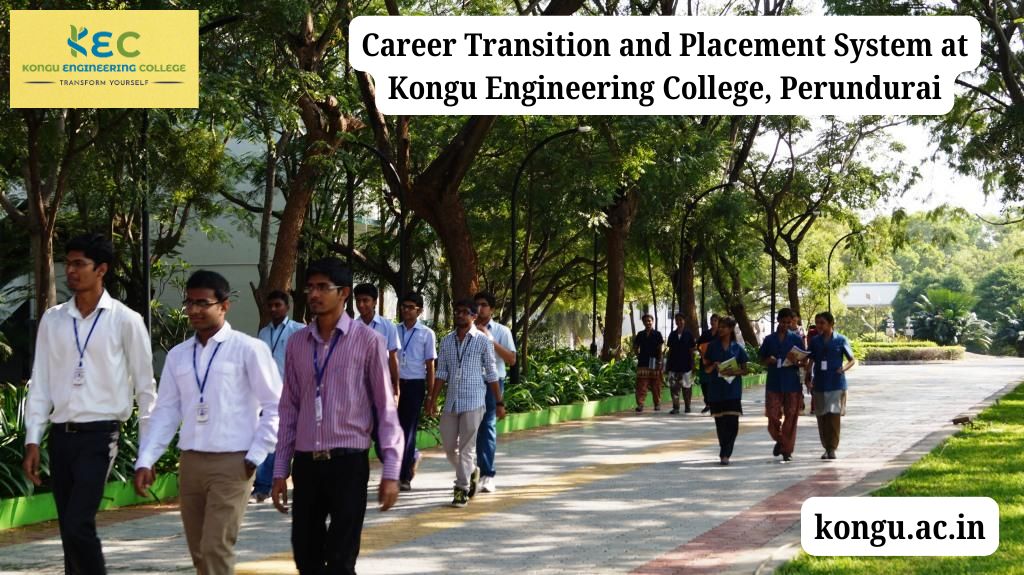
The Placement System at Kongu Engineering College functions as a structured institutional framework that supports students as they move from academic study to professional employment. Campus recruitment activities are coordinated for both undergraduate and postgraduate programmes through established institutional processes. Placement activities are planned alongside academic schedules and departmental coordination. This alignment allows recruitment to progress in an organised manner without interrupting academic responsibilities. Central Placement Cell 1.The Placement Cell at Kongu Engineering College has been functioning since 1998. 2. It acts as a formal link between academic departments and recruiting organisations. 3.The cell supports students during the transition from campus learning to workplace engagement. 4.It coordinates campus recruitment activities in an organised manner. 5.It facilitates communication between students and recruiting organisations. 6.It works with academic departments to align placement activities with academic schedules. Career Development and Student Preparation Career development support forms a core component of the placement framework. Students receive guidance to understand career pathways, role expectations, and recruitment processes across different sectors. Preparation activities are organised in areas such as: These activities help students approach campus recruitment with clarity while continuing their academic coursework. Industry Linkages and Internship Support The Placement Cell maintains ongoing interaction with industry professionals and organisations. These relationships support campus recruitment drives, internship opportunities, and structured industry–academia engagement. Information related to employment opportunities and internships is shared through institutional channels, enabling students to track and prepare for opportunities in a systematic manner during the later stages of their programmes. Recent UG and PG Placement Outcomes 1. Recent graduating batches show steady placement activity across both undergraduate and postgraduate programmes. 2. Campus recruitment supports students in moving from academic completion to professional roles through organised recruitment cycles. 3. In undergraduate four-year programmes, many students secure employment through campus recruitment, while some choose to continue with higher studies. 4. Postgraduate two-year programmes also record consistent placement participation, in line with their programme size and academic focus. 5. Across recent academic cycles, undergraduate programmes show a gradual increase in student participation in placements, reflecting continuity in recruitment activity. Recruiter Participation Recruitment activity involves organisations from different sectors engaging with the campus through structured recruitment processes. Recent engagement has included organisations such as: These engagements form part of the institution’s ongoing interaction with industry and are conducted within established academic and recruitment frameworks. Placement as an Institutional Process Placement activity at Kongu Engineering College is integrated into the broader academic lifecycle. Coordination between departments, students, and the Placement Cell ensures that recruitment activities follow institutional procedures and academic timelines. Rather than functioning as a separate event, placements form part of the structured progression from academic completion to professional engagement. Role of the Placement Framework The Placement System at Kongu Engineering College provides a regulation-aligned pathway for career transition. Through coordinated preparation activities, long-term industry interaction, and organised recruitment processes, the framework supports steady movement from campus learning to employment within a stable institutional environment.
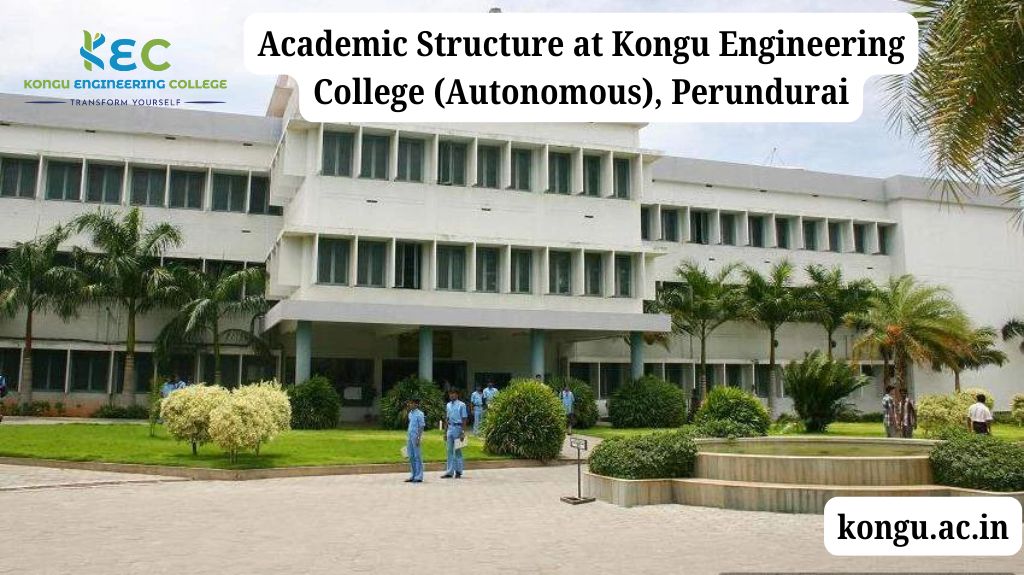
Academic Structure at Kongu Engineering College (Autonomous), Perundurai
The Academic Structure at Kongu Engineering College is organised within an autonomous academic framework while continuing its affiliation with Anna University. This structure enables the institution to frame its own academic regulations and curricula within the guidelines of the affiliating university. Academic activities follow clearly defined regulations and academic calendars that specify teaching schedules, assessment periods, and examination timelines across programmes. Each admitted batch follows a separate regulation document. These regulations outline curriculum structure, credit requirements, contact hours, and evaluation methods for theory courses, laboratory work, and project components. This regulation-based approach ensures consistency across departments and provides students with a predictable academic pathway from admission to programme completion. Academic Departments and Programme Framework Kongu Engineering College offers academic programmes across four broad categories: Engineering education is delivered through departments including Civil Engineering, Mechanical Engineering, Electrical and Electronics Engineering, Electronics and Communication Engineering, Electronics and Instrumentation Engineering, Computer Science and Engineering, Information Technology, Artificial Intelligence and related specialised areas. These programmes are supported by applied sciences departments that handle foundational courses in Mathematics, Physics, Chemistry, and English. Each department functions within a common institutional framework while managing its own syllabi, laboratory courses, electives, and assessment methods. Academic coordinators and department-level boards oversee curriculum delivery, timetable planning, and monitoring of academic progress in alignment with institutional regulations. Examination and Evaluation System Examinations and evaluation processes are administered through the office of the Controller of Examinations. This office is responsible for scheduling examinations, implementing academic regulations related to assessment, processing results, and maintaining academic records. The evaluation framework includes: Final course results are calculated by combining internal assessment marks and end-semester examination marks as specified in the regulation document applicable to each batch. Academic Committees and Governance Academic quality and governance are supported through structured institutional committees. The Internal Quality Assurance Cell plays a key role in monitoring academic standards, supporting academic planning, and reviewing teaching and learning processes. Research activities and intellectual property matters are coordinated through the Research and IPR Committee, with representation from academic departments. Academic governance operates within statutory and affiliating university norms through documented institutional policies, councils, and review mechanisms. Learning Support and Academic Environment The central library serves as a core academic support facility, providing access to books, journals, and digital academic resources through technology-enabled services. Digital academic support is strengthened through an ERP-enabled system that supports access to academic information, examinations, and administrative services. Student support structures include the Students Counselling Cell, Universal Human Values Cell, grievance redressal mechanisms, and a 24×7 women help line, providing academic and personal support within the campus framework. The institution follows a formal Code of Conduct governing academic discipline and campus behaviour. Attendance norms, classroom discipline, restrictions on mobile phone usage, and anti-ragging regulations contribute to a calm and structured academic environment. Role of the Academic Framework The Academic Structure at Kongu Engineering College brings together autonomy, regulation-driven processes, and continuous assessment to support steady academic progression. Clearly defined programme structures, evaluation systems, and support mechanisms help students move through each semester within a stable and well-organised learning environment.
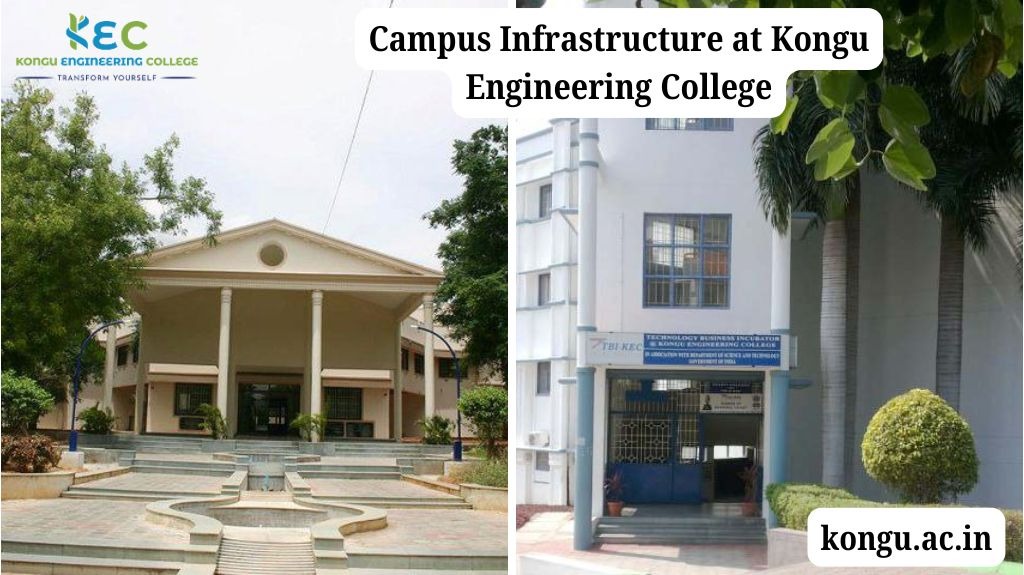
Campus Infrastructure at Kongu Engineering College, Perundurai: Classrooms, Labs and Facilities
Our institution offers a well-structured academic environment spread across a 167-acre campus at Perundurai, Erode. The Campus Infrastructure at Kongu Engineering College is designed to support academic learning, practical education, research activity, and an organised student routine. Each facility functions within a disciplined framework that aligns with the institution’s academic schedule. Classrooms and Teaching Facilities Classrooms support regular lectures and academic interaction. Seating layouts and classroom arrangements allow faculty members to conduct sessions in a focused and organised manner. Many classrooms are ICT-enabled, supporting the use of digital teaching tools and visual resources during instruction. Laboratory Infrastructure Laboratories play a central role in engineering education. Each department maintains dedicated laboratories aligned with its academic curriculum. These facilities support experiments, demonstrations, and project-based learning, allowing students to apply theoretical knowledge within a controlled academic environment. Central Library and Learning Resources The central library serves students and faculty across disciplines. It provides space for reading, reference work, and academic preparation. Working hours: The library supports access to academic and digital learning resources as part of the campus study routine. Computing and Digital Infrastructure The campus provides more than 1200 computers across departments and dedicated computer centres. These systems support academic work and institutional activities. Campus-wide Wi-Fi connectivity enables digital academic access. An in-house ERP system supports learning, examinations, academics, and administrative functions. Innovation and Research Infrastructure The campus includes a structured innovation ecosystem that supports academic exploration beyond classrooms. This includes: These facilities support idea development, experimentation, and academic innovation within institutional guidelines. Hostel and Residential Facilities Hostel accommodation is available within the campus to support a structured residential life. Separate hostel facilities for boys and girls follow permission-based entry systems to ensure discipline and safety. Health, Fitness, and Campus Amenities The campus includes an air-conditioned fitness centre supporting student well-being. Daily campus needs are supported through: Safety, Discipline, and Campus Environment The institution follows strict safety and discipline systems, including anti-ragging regulations, identity card usage, helmet rules, and monitoring committees. Green spaces and water management systems support a clean and orderly campus environment. Role of Infrastructure in Academic Life The Campus Infrastructure at Kongu Engineering College supports focused learning, practical education, and structured campus life. Each facility contributes to a calm, organised environment where academic activities progress steadily.
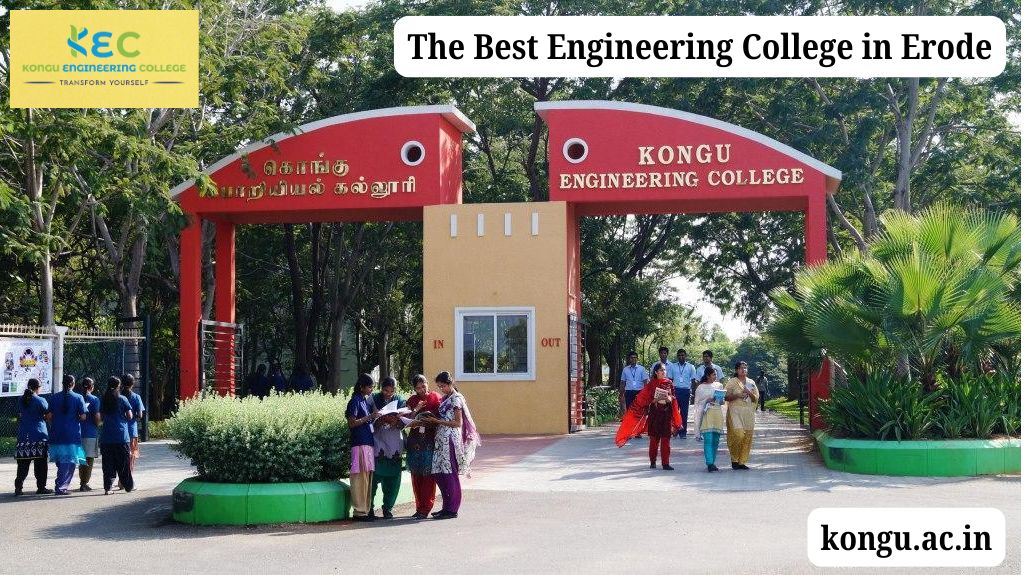
Kongu Engineering College – The Best Engineering College in Erode
For more than forty years, Kongu Engineering College has built an academic environment defined by purpose, clarity, and sustained progress. Set in Perundurai, our campus provides a calm and well-structured setting where students can focus deeply, learn consistently, and grow with confidence. This long-standing commitment to meaningful education continues to shape our identity as The Best Engineering College in Erode. Our Beginning Established in 1984 under the Kongu Vellalar Institute of Technology Trust, the institution was created with a clear intention: to offer disciplined and thoughtfully designed technical education for learners from every region. Over the decades, this vision has guided our steady expansion and academic refinement. Today, the college stands affiliated with Anna University, approved by AICTE, accredited by NAAC with an A++ grade, and supported by autonomous status valid till 2033. Many of our programmes are also accredited by the NBA, reflecting the strength and consistency of our academic systems. Courses We Offer Our academic portfolio covers engineering, technology, science, architecture, and management, offering students a wide and future-ready pathway. Undergraduate Programmes Postgraduate Programmes Doctoral and Applied Sciences Programmes We offer research opportunities across engineering, sciences, management, and humanities, along with specialised UG and PG applied science programmes that support industry-focused learning. Across all departments, academic progress is shaped through hands‑on labs, structured coursework, guided assessments, and project-based exploration, enabling students to advance through a well-supported learning journey. Our Campus The campus is designed to encourage steady focus and purposeful learning. Academic blocks, laboratories, and shared spaces are arranged with clarity, ensuring that students experience a sense of order throughout their everyday activities. Bright classrooms, fully equipped labs, and a central library with extended study hours support a disciplined academic routine. Students also benefit from: Digital infrastructure strengthens this environment through ICT-enabled classrooms, a campus-wide Wi-Fi network, an in‑house ERP platform, and more than 1200 computer systems. The college also operates a dedicated FM station (90.4 MHz) that supports academic and cultural communication. Campus Conduct The college fosters a respectful and well‑organised atmosphere that helps students stay focused and confident in their daily academic life. Support systems across the institution work together to guide learners, address concerns, and ensure that the campus remains steady, safe, and student‑centred. Research and Innovation Our research culture is supported by: Students and faculty work together on experimental studies, prototypes, industry-linked projects, and academic research. Workshops, conferences, and technical events are integrated into the calendar, creating a dynamic and forward‑looking academic environment. Placements The placement process at KEC follows a steady and organised model that has evolved over many years. Students receive training, guidance, and structured exposure to industry expectations before participating in recruitment drives. Companies from engineering, technology, research, manufacturing, and related sectors visit the campus to offer diverse opportunities. This seamless connection between academic learning and professional entry paths reinforces the institution’s reputation as The Best Engineering College in Erode. Moving Forward KEC continues to progress with the same clarity and purpose that shaped its early years. The focus remains on providing a campus where learning is structured, environments are calm, and academic practice is consistent. Students who seek an organised and thoughtful place to build their future find lasting value here. Through four decades of uninterrupted commitment to quality education, we continue to uphold our position as The Best Engineering College in Erode.